
BY
BEN C. ABRAHAM
INTRODUCTION
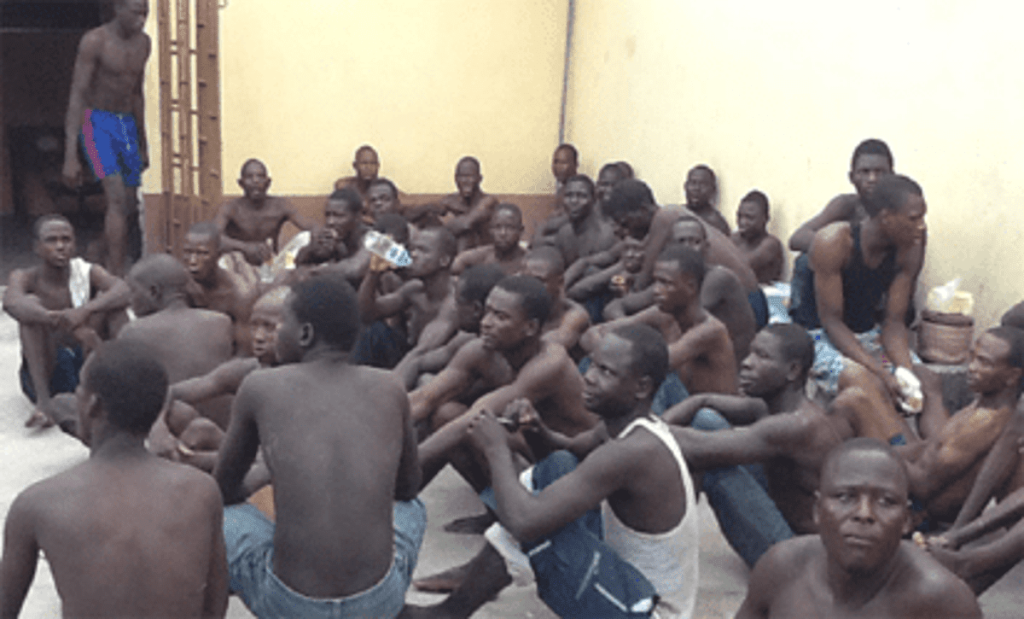
This brief intervention is aimed at situating the issue of decongestion of correctional centres in proper perspective making copious reference to a template used in the past. It is no longer headlines that our correctional facilities are bursting at the seams, congested to a point of fatality. It has been so for quite some time. One must acknowledge the institutional interventions made by key stakeholders to reduce this menace. Sadly however, the ‘congestion beast’ has clearly refused to be tamed. Criminal justice administration is a system that has many parts working in concert to deliver justice in the true sense. It goes without saying therefore that when one or more parts constitute a clog, the system will be bogged down and unable to deliver effectively. This is the case presently. And the result is the high numbers we see in these facilities. A facility like Ikoyi correctional centre in Lagos State which has a maximum capacity for about 800 inmates presently has about 3000 inmates; over 300% congestion rate. This is the position in Port Harcourt, Kano, Oshogbo and Kebbi amongst others.
While this brief is not to identify the parts of the system which constitute the clog, it is for us to look at a template used in the past by a former Chief Judge of Lagos State and to propose such as an ad hoc measure pending when all the parts of the system work in tandem.
Hon Justice Augustine Ade Alabi CJ (now retired) was the Chief Judge of Lagos State from 2004 to 2009. His lordship made the decongestion of the prisons one of the cardinal objectives of his tenure. As at 2004, the correctional facilities were also heavily congested with attendant poor welfare conditions faced by the inmates.
THE KEY CHALLENGES
The major challenges that faced the criminal justice administration system which orchestrated the congestion were;
- The inability of the police to transfer duplicate case files for felonies to the office of the DPP. The case files were either not transferred or transferred after much delay. In 2004, the Lagos Criminal Information System (LCIS) had not yet been established. (We will look at this in a separate write up).
- The delay in the issuance of legal advice by the office of the DPP.
- Other administrative challenges like inadequate logistics for taking inmates to court (the black maria). The vehicles were initially operated by the Police. When they were handed over to the Prison authorities maintenance problems continued. There were also issues around absence of; Judges or magistrates, prosecuting counsel or lay police prosecutors, defence lawyers and witnesses. (Most of these ones persist today).
THE APPROACH
His lordship approached the task through a multi-sector engagement method. He stated that he would carry along other stakeholders in the system even though he made it clear from the get-go that he recognized his powers as a Chief Judge and was ready to deploy same without breaching extant laws; a stance which made all the difference. The following steps were undertaken
- A criminal justice committee was set up. Members were drawn from the Ministry of Justice, the Police, the Judiciary, the Prisons and the NGOs. The CJ informed the committee of his plan for mass decongestion and sought their cooperation.
- The NGOs were asked to go to the prisons and collate names of awaiting trial inmates who had been in custody without trial for some years, especially those of them awaiting DPP’s legal advice.
- When the names were collated, bail applications were filed for them. The CJ graciously granted all the applications to be filed as official (non-payment of filing fees by the NGOs). The names and applications were to be vetted by the then DCR (Legal) of the Court at Ikeja Mrs L.A.M Folami (now a Judge of the High Court).
- The applications were served on the Respondents – Attorney General of Lagos State, Commissioner of Police and Controller of Prisons (read corrections). The Respondents were expected to respond accordingly.
- The CJ required the NGOs to have some capacity for rehabilitation and reuniting the beneficiaries with their families, a task that many of the Organizations undertook creditably.
- In a manner of futuristic thinking and to avoid duplicity, His lordship advised the NGOs to form a body to coordinate their activities and interface with funding and other groups if and when they come. In reaction to His lordship’s hint, a group known as Alliance of Non-Governmental Organizations International (ANGOI) was formed.
- To make for ease of adjudication, the CJ assigned a few Judges to handle the applications. His lordship also handled a number of applications in his court (Court No 1 at Ikeja).
- After issues were joined, the bail applications were heard and the courts gave their ruling.
- The CJ ensured that applications were heard timeously hence he informed all parties and stakeholders that he would brook no time-wasting tactics. His lordship did so and ensured so.
- In the process, thousands of inmates were at least given bail and released from custody pending whenever their case files came up and information filed in the matter.
THE RESULTS AND LESSONS
The task embarked on by His lordship was herculean, almost impossible, not without grumblings especially from the Police (why should my lord release armed robbers and all that) but the result was a radical decongestion of the correctional facilities in Lagos State. The perennial issue of non-transmission of duplicate case files from the Police to the office of the DPP was briefly albeit ably dealt with. The inmates who had stayed for upwards of 10 years without trial (and there were many of them) at least were granted bail. By the way which law in Nigeria supports keeping an inmate in custody awaiting the ‘almighty’ DPP’s advice for 10 years? Hon Justice A. A. Alabi CJ (now retired) tried something audacious, devoid of political or legal ‘correctness’ and lives were saved, destinies restored and the system realized that a new sheriff came to town.
The lessons are numerous. The system already has built in levers for accomplishment of tasks, in this context the criminal justice administration system. One thing that stands out is that where there is a will to do something, the way to do it will emerge. This approach, with some tweaking here and there, can be adopted today to approach decongestion of correctional facilities.
As I round off, it is pertinent to note that the correctional facilities are still congested. In Lagos State for instances there is the LCIS which has helped to reduce incidences of no case files, enable the tracking of the DPP’s legal advice, reduce duplication of applications amongst others. I must add that despite the huge success of the LCIS, a number of inmates are still in Lagos correctional facilities awaiting DPP’s advice for years, awaiting filing of information (after DPP’s advice), awaiting arraignment in courts, awaiting trial, undergoing trial slowly, awaiting re assignment of their case files after the retirement, demise or secondment of the Judges, or as a result of destroyed case files (the ENDSARS protest). There are those (a few though) whose cases have been struck out but no release warrant issued for them. (We have handled some of this category in the past 3 years and presently handling one referred to us by the Records Department of the Ikoyi facility – the order for the inmate’s release was made by a Yaba Magistrate court since December 2025 but is still in custody) Then there are some of the inmates who are just there; they have not been to court in a while (even in simple offence cases in Magistrate courts). In another write up, I will make a case for auditing of the inmates in these correctional facilities to determine each inmate’s status.
BEN C. ABRAHAM is a lawyer and the founder of ZAREPHATH AID, a Criminal Justice and Correctional Reform based Organization.
www.zarephathaid.org
ZAREPHATH AID was one of the NGOs that worked with the then CJ in the said decongestion exercise. The bail application we filed was via Suit No. ID/6m/2005, Between Monday Okorie & 45 Ors vs COP Lagos State & Anor. On the 3rd of August 2005, the CJ granted bail to 34 of the applicants. It is noteworthy that the longest staying awaiting trial inmate in the Medium Prison Kirikiri Lagos State who stayed for almost 12 years awaiting DPP’s advice was one of the 34 beneficiaries. Notably also two women were released amongst the 34 persons.