
By Stephen Simon
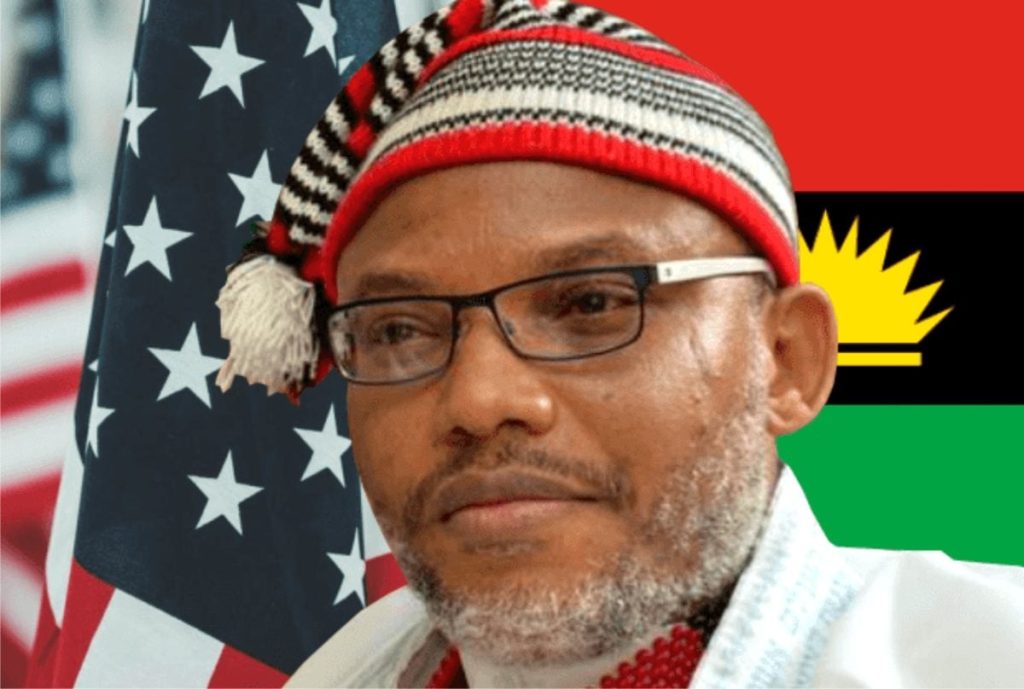
The Indigenous People of Biafra (IPOB) has announced the indefinite suspension of its leader and founder, Nnamdi Kanu, in a dramatic development that could reshape the future of the separatist movement he established more than a decade ago.
The group also announced the removal of Kanu as Director of Radio Biafra, describing the decision as part of efforts to reposition the organisation, strengthen its internal structure and prevent individuals from acting in its name without authorisation.
The decision was disclosed in a statement issued on Thursday by Chikadibia Edoziem, Head of the Directorate of State (DOS), IPOB’s highest decision-making body.
According to the statement, the decision was reached during a DOS meeting held on June 17 after members reviewed an intelligence report allegedly submitted by IPOB’s internal intelligence unit, known as the M-Branch.
Edoziem said the report contained information concerning an alleged meeting involving Kanu and officials of the Department of State Services (DSS) and the National Intelligence Agency (NIA) while he was in custody at the Sokoto Correctional Centre.
He stated that the DOS considered the report and resolved that suspending Kanu indefinitely was necessary to safeguard the organisation and prevent actions capable of undermining its objectives.
The group maintained that IPOB was established as a self-determination movement by Biafrans in the diaspora and not by any individual, stressing that no single person has the authority to dissolve or override its leadership structure.
According to Edoziem, intelligence available to the organisation suggested plans to establish a new militia through which violence could be unleashed in the South-East, while efforts were also allegedly being made to weaken and eventually dismantle IPOB’s leadership structure.
He added that the suspension would prevent individuals from claiming authority from the office of the IPOB leader to engage in criminal activities or actions inconsistent with the organisation’s mission.
“Any crime or criminal activity carried out in the name of the suspended office of the leader shall not be attributed to IPOB but solely to those responsible for such actions,” the statement said.
The group further stated that it would no longer accept responsibility for actions undertaken by individuals or groups not authorised by the Directorate of State to act on its behalf.
The decision represents one of the most significant internal developments in IPOB since its formation in 2012 by Kanu, a British-Nigerian activist who emerged as the face of renewed agitation for an independent Biafran state.

Through Radio Biafra broadcasts and a growing international network of supporters, Kanu gained prominence by advocating the secession of Nigeria’s South-East and parts of the South-South regions to form the Republic of Biafra.
His activities attracted widespread support among some groups in the region but also generated strong opposition from the Federal Government, which accused IPOB of threatening Nigeria’s unity and national security.
In September 2017, the Federal Government officially proscribed IPOB and designated it a terrorist organisation following a series of confrontations between security agencies and members of the group.
Kanu first gained national attention after his arrest in October 2015 on charges bordering on treasonable felony and related offences. Although he was granted bail in 2017, he fled the country after a military operation at his family residence in Afaraukwu, Abia State.
For several years, he remained outside Nigeria until his controversial arrest and return to the country in June 2021.
Nigerian authorities said he was intercepted through international security cooperation, while his supporters maintained that he was unlawfully renditioned from Kenya.
Since his return to Nigeria, Kanu has remained in custody and faced a prolonged legal battle over terrorism-related allegations brought against him by the Federal Government.
In November 2025, Justice James Omotosho of the Federal High Court in Abuja convicted Kanu on multiple terrorism-related counts and sentenced him to life imprisonment.
The court imposed life sentences on counts one, four, five and six of the charge, while additional prison terms of 20 years and five years were imposed on separate counts.
During the trial, officials of the Department of State Services testified that Kanu made statements capable of inciting violence and attacks on security personnel. Another prosecution witness linked violence that followed the #EndSARS protests to comments allegedly made by the IPOB leader.
Despite Kanu’s incarceration, his continued influence within sections of the pro-Biafra movement has remained a subject of debate, with different factions claiming to represent his position and the broader objectives of IPOB.
Political analysts and security observers say the decision by IPOB’s Directorate of State to suspend its founder underscores growing internal tensions within the movement and may signal a major shift in its leadership structure.
The development is expected to generate fresh reactions from Kanu’s supporters, legal representatives and pro-Biafra groups, while raising new questions about the future direction of IPOB and the broader separatist campaign in the South-East.
For now, the suspension marks an unprecedented chapter in the history of the organisation, with observers closely watching how the movement navigates the post-Kanu leadership challenge while pursuing its long-standing goal of Biafran self-determination.